
Anthony Ing is a British and Canadian artist filmmaker, composer, and co-founder of production company Loop.Alongside their directing and editing work, they have produced several documentary shorts and features, that have been selected for festivals including SXSW, AFI, Rotterdam and Sundance. Jill Uncredited screened in SELF MADE at Fabrica (October 2025)
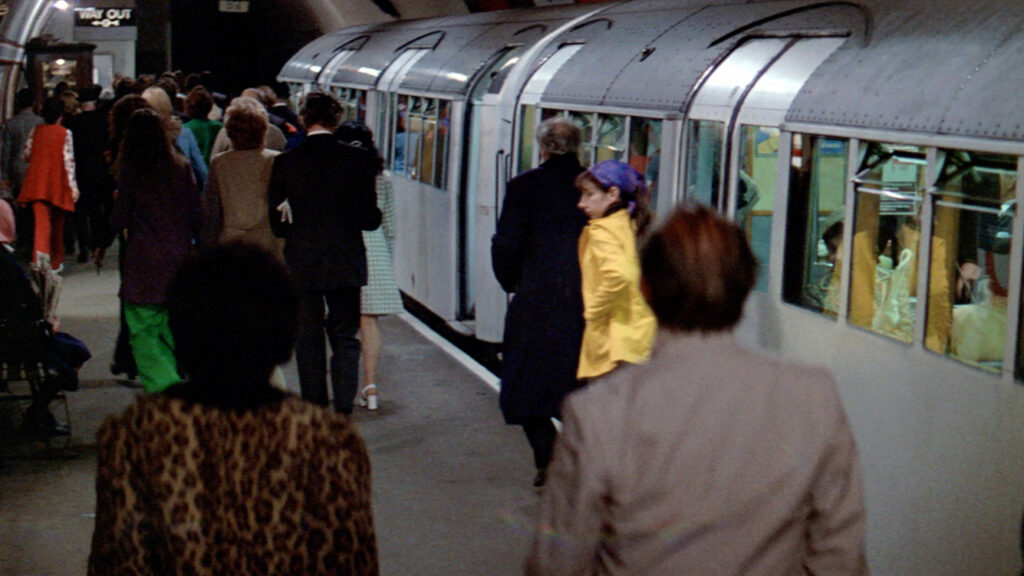
Jill Uncredited is a poetic and quietly powerful study of Jill Goldston, a woman background actor. What fascinated you about uncredited roles and how did you go about finding Jill?
AI: Thank you. The seed of the idea came about years ago when I was scrubbing through film archives doing research for another project. Sometimes your mind starts to wander in these moments and you start to focus on things beyond the task at hand. I realised how alluring it was to focus on background actors who you couldn’t easily look up, or go on a wikipedia page for. I held onto that feeling, and when I stumbled across Jill’s career years later – and her reputation as the most prolific extras in the world – she seemed like a perfect subject. After meeting with Jill, she gave me a list of all the jobs she worked and I spent years carefully going through film and TV footage to find her. Then used that material to make the film. I’m pleased to find that Jill does actually have her own wikipedia page now.
As a filmmaker who works with collage and montage, how did this film take shape in terms of choosing clips and organising edits? Was it a similar process to previous work?
AI: To be honest, I was probably excessively organised on this project. It was a similar process I had done for my first film, ‘Day After Day’, I collected all the clips of Jill from the best available physical media, and then used a tagging function with keywords to basically create a bespoke, searchable library in Final Cut. It was clinical work really, but I knew it would pave the way to be more creative in the edit. I suppose a simple analogy is like how a well organised palette of colours allows a painter to make quick intuitive strokes, but if they have to keep stopping to search their store cupboard for a particular tin of paint, it would completely disrupt the flow of the creative process. But the cataloguing also helped establish the themes, because you would see recurring motifs, and you would understand what typical roles for Jill were, and times when she seemed most in her element (dancing for instance) and these patterns always chimed with the conversations I had with her too. Once I was all set up, and started to understand what direction the film was going in stylistically, the process became one of playfulness and experimentation. It took a long time to get to that stage though.
Your film ‘Day after Day’, described as a ‘masterful recut’ by Nowness, looks at the on-screen representation of Doris Day. Will future projects continue to focus on the roles of women in film- and will you continue to explore the possibilities in re-editing existing film and archive footage?
AI: I don’t have another project specifically about women in film lined up, although I am in the early stages of researching some adjacent things at the moment. My work will continue to focus on ‘outsiders’ in one way or another, and I remain very interested in the relationship between performance, identity and social systems. I think I have perpetually unresolved issues around identity, particularly in regards to gender, so I’m always going to be interested in those of us who are searching for a role to play: either looking for a sense of belonging, for an escape, or just self-preservation. I’m working more on scripted projects recently, but I think it’s unlikely I will ever abandon archive work completely; there’s so many rich and interesting cultural artifacts in the past.
The music and sound veer from a melodic piano to sound effects and, importantly, silence. At what point in the process did you start to think about sound design and how you wanted to create it?
AI: I had a temporary score laid down in the edit quite early on, I knew I wanted the music to track the emotional aspect, so that was on my mind when I composed the soundtrack. But the sound effects were more about evoking that tactile, detached sense of an archive dig – with analog clunks and clicks. The brilliant sound designer Tom Jekins really brought those elements to life. So there’s kind of a contrast between the sound of ‘the archive’ and the music that looks to evoke Jill’s human experience. Between it all, the moments of silence hopefully allow some space for reflection.
You can watch Jill Uncredited now online Here
The film screened exclusively on MUBI from November 29, 2023, in the series Brief Encounters. Read the introduction to the film in Mubi Notebook